
Acupuncture: more than needles & pain
Acupuncturist Toolkit
Most hear the term “acupuncture” and think of needles… and of course they would not be wrong! BUT it is not the whole picture of how Acupuncturists can support people. Acupuncture has a rich and complicated history - as does anything with over 2000 years of history. What we think of as Acupuncture in the West falls typically under the umbrella of Traditional Chinese Medicine (TCM). In BC, Acupuncturists are regulated by a College that outlines our scope of practice based on TCM principles (College of Complementary Health Professionals of British Columbia, 2026).
Some of the therapies that Registered Acupuncturists can use to support people include:
Acupuncture - the thin needles you think of :)
Moxibustion - burning of a herb known as mugwort to warm up acupuncture points
Cupping - the practitioner creates a vacuum inside of cups made of glass (fire cupping) or silicone to form a strong suction onto the skin and tissues beneath releasing tension and stagnation
Electrical Stimulation - applying a small current through two adjacent acupuncture needles
Tuina - an umbrella of specific massage techniques that support moving qi and blood (promote healthy circulation) throughout the body
Diet therapy & lifestyle advice - self explanatory, but from a TCM view rather than from a Western lens
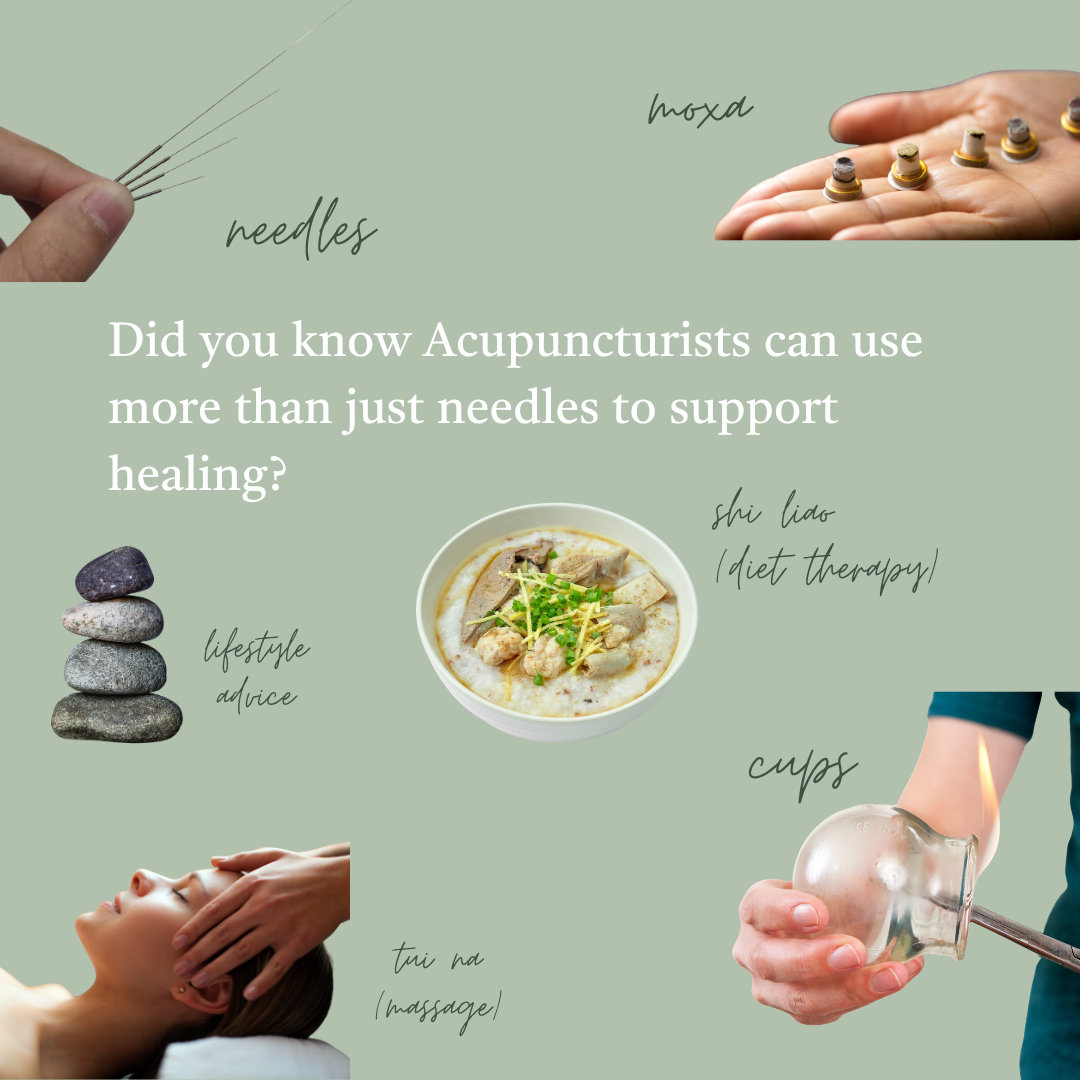
Therapies and modalities that Registered Acupuncturists in BC are able to use to support people based on their individual needs.
Acupuncture is NOT Dry Needling/IMS, but it CAN treat Orthopedic Injuries! That’s just not ALL it does…
Something I have noticed when I have mentioned that I am an Acupuncturist is that the response is often along the lines of: “Oh, I have had acupuncture when I got tennis elbow, I’ll keep you in mind for if I get injured again!" or “Oh my Physiotherapist gave me Acupuncture when I hurt my hip and it was so painful”.
It is totally true that acupuncture can treat injuries from sport, repetitive strain, accidents, or the like…. it simply is not the whole picture.
Acupuncture can treat a variety of ailments that are more external - in TCM (very simply put) we talk about injuries to the 12 meridians or channels as being more external, and that would apply to what we refer to as Orthopedic Pain conditions in our Western Culture. Some of these include joint sprains, muscle strains or “pulls”, muscle “knots”, pinched nerves, or tendonitis (HealthLink BC, n.d; Maciocia, 2015).
It’s also true that many other practitioners are licensed to administer needles for pain relief… it’s just not Acupuncture. What people are typically referring to when they’ve received a treatment involving needles from a Physiotherapist is called “Dry Needling” or Intramuscular Stimulation (IMS). This involves the insertion of needles into an affected muscle tissue typically at a local “trigger point” (colloquially a muscle “knot”) to release the tissue and promote healing (Medical News Today, 2024). This treatment has been really effective for many people - BUT BUT BUT it is not Acupuncture. I am not here to slam this modality nor the practitioners that administer it, I have talked to many people for which it has been life changing, I simply think it is worth further differentiation.
As mentioned previously, Acupuncture theory is rooted in 2000+ years of history and the points chosen are based on a series of channels and treatments are most often planned based on a comprehensive diagnostic process for which the practitioner attended years of schooling to learn. An Acupuncturist may needle a trigger point and elicit the same release that an IMS therapy is aiming for, only it won’t be their standalone plan and most won’t be manipulating the needle as harshly - so in most cases it will hurt A LOT LESS. Acupuncturists are trained to look at the entire body as system wherein nothing can be separated from the whole. Every injury or ailment is assessed as a part of a whole system, and an injury on your arm is treated as a channel pathology that by TCM theory may stem from a broader issue somewhere entirely different!
This is where Acupuncture becomes more than just needles and pain. It treats systems - channels that have inextricable links to internal organs. In this view the body is not just a machine with sometimes faulty mechanics or a broken engine, but rather an ecosystem that can sometimes find itself out of balance for one reason or another. We look locally and we zoom out. (Maciocia, 2015)
Acupuncturists Can Treat Internal Medicine Dis-eases
When we zoom out and look at the body from a TCM lens, we see patterns and propensities. Everyone’s unique ecosystem that is constantly changing - a system that can innately find its own balance when we are in good health, but may need support in other times.
Symptoms become apparent when we shift out of the healthy and normal ebbing and flowing, we acquire stagnation or we become deficient (to put it as simply as possible). Every dis-ease has symptoms and the collection of these that varies case to case becomes a pattern. The acupuncture points along the channels, each linked to specific organs, help us to direct the ebbs and flows where they might need redirecting. They help us to impart innate wisdom into a system that needs a reminder of its nature.
From a framework that looks very different to Western Medicine, an Acupuncturist can help to support the treatment of a variety of ailments that may be surprising if you are unfamiliar.
A few of the most common ailments that Acupuncture is great at supporting are:
Chronic pain conditions
Acute pain and associated injuries
Digestive concerns (IBS symptoms, constipation, diarrhea, bloating, nausea)
Headaches (migraines, hormonal headaches, tension headaches, etc.)
Mental health conditions (anxiety, depression, addiction, stress)
Sleep issues (insomnia, parasomnia)
Fertility & pregnancy
Hormonal disturbances (menopause, menstrual disorders, menstrual pain, infertility, ovulation issues, breast pain, erectile dysfunction)
This list (CTCMCPANL, n.d.; Healthlink BC, n.d.) is far from exhaustive so if you have any questions about whether Acupuncture might be able to support you with whatever affliction you are dealing with, please feel free to reach out and we can explore that together!
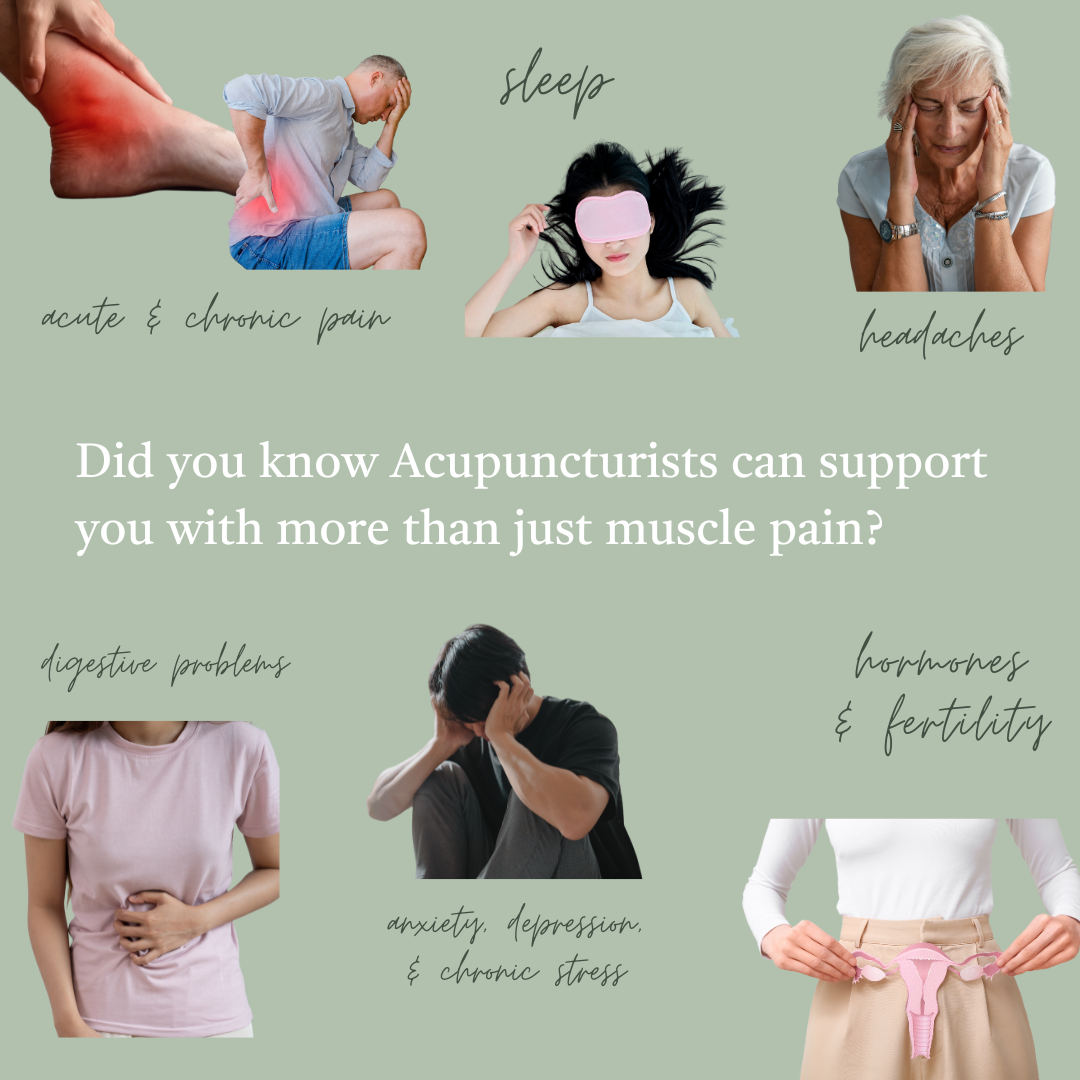
Some common ailments for which Acupuncture can support symptom relief.
References:
College of Traditional Chinese Medicine Practitioners and Acupuncturists of Newfoundland and Labrador. (n.d.). What health conditions can acupuncture treat?https://ctcmpanl.ca/what-health-conditions-can-acupuncture-treat/
College of Complementary Health Professionals of British Columbia. (2026, May). Scope of practice explanatory statement: Traditional Chinese medicine and acupuncture (TCMA). https://cchpbc.ca/wp-content/uploads/2026/05/SoP.ExplanatoryStatement-TCMA.V8FINAL.pdf
Giovanni Maciocia. (2015). The foundations of Chinese medicine: A comprehensive text (3rd ed.). Elsevier.
HealthLink BC. (n.d.). Acupuncture. https://www.healthlinkbc.ca/healthwise/acupuncture
Medical News Today. (2024, October 16). Dry needling vs. acupuncture: What the research says. https://www.medicalnewstoday.com/articles/321989
